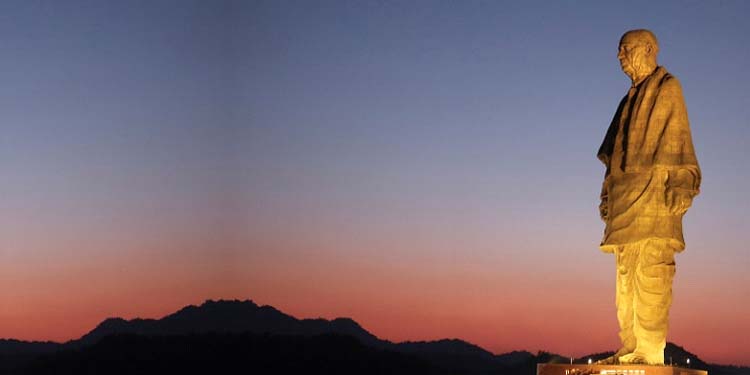
Situated on the West Coast of India, the state of Gujarat has a lively character to it, which has helped to enrich the Indian canvas of art, architecture, culture, music, painting, folk and other fine arts. It is known for a rich heritage of handicrafts, customs and traditions, fairs and festivals and an amazing variety of wildlife. This land is also famous for personalities like Mahatama Gandhi - the father of the nation, Sardar Patel - the iron man of India and social reformers like Swami Dayanand Saraswati. With a rich coastline extending to 1,600kms, which accounts for over one third of Indian coastline, Gujarat traded with western countries since the days of Greeks and Romans and is said to have an ancient Indian port at Lothal which had maritime connections with Egypt and Mesopotamia. Earlier ruled by the Hindu Rajput kings and then the Mughal emperors, Gujarat came under British rule as part of the Bombay presidency. Today, with a large Jain population and a strong influence of Buddhist culture since Ashoka's time, Gujarat boasts of a secular culture, which accounts for its glory and character.
Ahmedabad
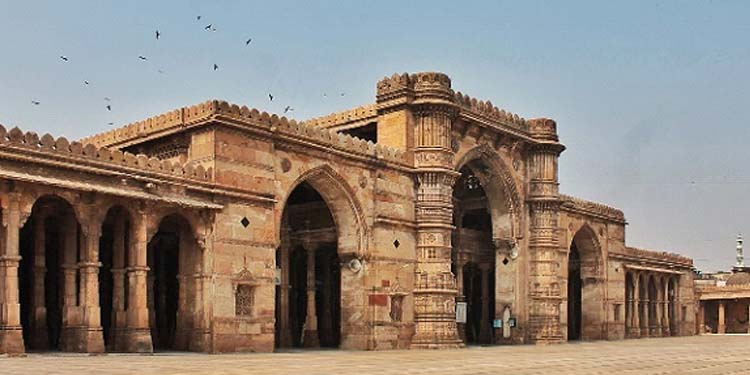
Ahmedabad the largest city in Gujarat blends an ancient heritage with a vibrant present. It nurtures in its pages of history, a breath of harmony and a show-case of exquisite harmony. The city is named after a Sultan who founded it in 1411 and graced it with splendid monuments. Ahmedabad is also known for its association with the Apostle of peace Mahatma Gandhi whose ashram is on the banks of River Sabarmati which is now a national pilgrimage site. Ahmedabad is the second largest prosperous city in Western India. It is a place where tradition and modernity co-exist in perfect harmony. The climate of the state is moist in the southern districts and dry towards the northern sides. Ahmedabad has been a city where a lot of action, reaction and interaction between various ethnic and linguistic forces have taken place which has resulted in the synthesis of many races and cultures. It is a land of gentle, dignified people, astute businessmen, gay, colorful peasants, and thriving industry.
Baroda

Baroda The beautiful princely state of the Maratha Gaekwad rulers, prior to Independence is also known as the city of palaces. The actual name of the city was Chandravati, after its ruler the brave king, Raja Chandra. But later it was renamed after the abundance of Banyan trees known as Vad, on the banks of the river Vishwamitri, as Vadpatra. The present name Vadodra is one of the forms of that name and Baroda is the English version of Vadodra. Although the history of Baroda can be traced back to about 2000 years, the recent city came into prominence only after the Maratha rulers, Gaekwad took over in 1734. With Maharaja Sayajirao Gaekwad - III ascending the throne saw an era of great progress and constructive achievements in all fields. Baroda reached its zen ith during his reign. Sayajirao made many amenities and facilities available for the betterment of his masses. The railway and the MS College is his contribution to the city. Today Baroda is a pleasant city with many gardens and palaces and museums. The remarkably cosmopolitan city of Gujarat is a melting pot of many cultures. The discovery of oil and gas in Ankleshwar and North Gujarat led to the industrial development of Gujarat in a big way. The Baroda region is the largest beneficiary in the process of this industrialization. For the connoisseurs of exquisite silver jewelry and paintings, Baroda provides a perfect opportunity to go on a shopping spree. The textile, the food and the jewellery is the bonus after sightseeing of the beautiful city.
Bhavnagar
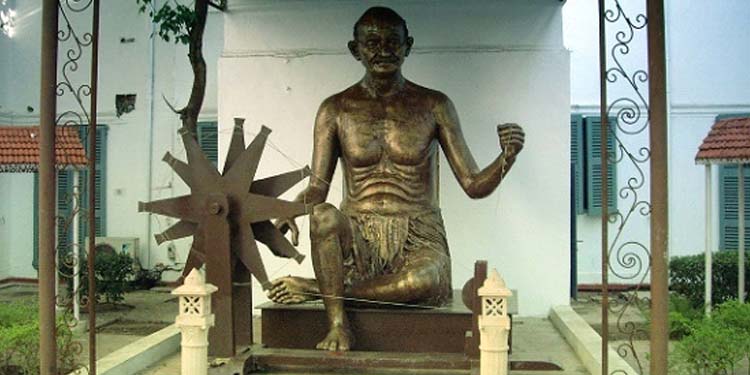
Probably the most recent princely states of India, Bhavnagar was established by Bhavsinhji Gohil to escape the wrath of Maratha invaders. He shifted his capital from Sihor to Bhavnagar in the 18th century, with the twin objectives of taking advantage of the sea as a defensive measure and to secure the advantages of maritime trade. The selected a site near the coast came to be known after his own name as Bhavnagar. Bhavnagar is a natural port. The problems of siltation during the low tide have been solved by making a lock gate, which enable big ships to float during the low tide. The great patriot Mahatma Gandhi's attendance in the college here has given this town a special mention in his biography.
Bhuj
Bhuj founded in 1548 AD by Rao Khengarji I, was the capital of the former princely State of Kutch. The historic city of Bhuj derives its name from the Bhujiyo Dungar, a hill, overlooking the present day Bhuj town from te east and has Hamirsar Lake on the west. You can lose yourself for hours in the intricate maze-like streets and alleyways of this fascinating town. There are walls within walls, attractive crenellated gateways, old palaces with intricately carved wooden pavilions, and striking, brightly decorated Hindu temples. Rao Pragmalji, who ruled Kutch from 1860 to 1876 AD, undertook many projects, such as- improvement of Mandvi harbor, construction of roads and irrigation works, hospitals, schools and a jail. Rao Pragmalji constructed three royal palaces- Prag Mahal and Ranjit Vilas Palace at Bhuj and Vijay Vials Palace at Mandvi.
Junagadh
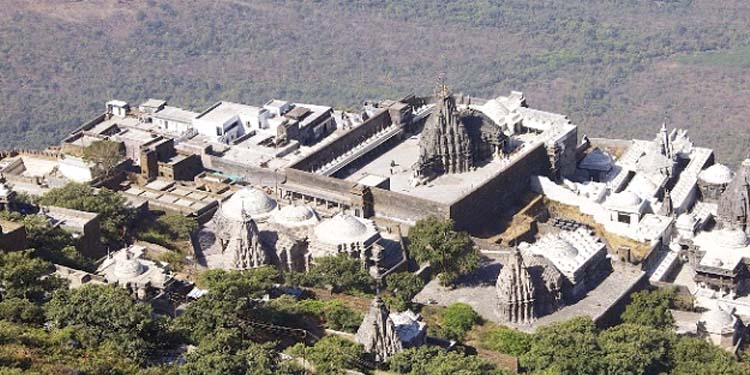
The ancient town of Junagadh breathes history. Junagadh's history can be traced back to nearly 250 B.C. This ancient fortified city rich in myth and legend, lies at the foot of Girnar Hill and takes its name from the Old Fort which circles the medieval town. History says that this old town was under the rules of many dynasties such as the Maurya, Kshatrapa, Gupta, Vilabhi, Chudasama, Gujarat Sultans and Babi Nawabs. But it was during the rule of Ashoka the great and later during the ruling tenure of the Babi Nawabs that the prosperity and the prominence of Junagadh grew. Both political powers and religious influences enriched the culture and created edifices leaving their mark on the architecture of Junagadh. Owing to the different dynasties and religions like the Hindu, Buddhist, Jain and later Islam, Junagadh provides a treat to the traveler. Various buildings of various time periods and influenced with various kinds of architecture can be sited in Junagadh. The Babi rulers of Junagadh, Nawab Mohhabat Khan II (1851-82 AD) undertook the beatification of Junagadh and patronized the construction of several building and urban design projects.
Somnath
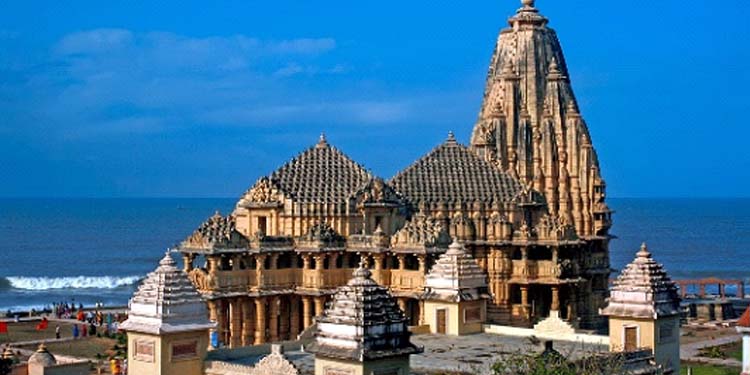
Situated 79 Kms. from Junagadh the legendary shore temple of Somnath is one of the twelve most sacred Shiva shrines in India. According to the legend, Somnath is as old as creation, built by none other than Som, the Moon God himself. Somnath was destroyed seven times and was always rebuilt. The temple has grown up from ashes, nearly seven times like the bird Phoenix. The present structure was built by Ahilyabai Holkar, the queen of Indore in 1783. It was full of a great treasury and when Mehmud of Gazni heard of it he looted the temple in 1026 A.D. and carried away all the treasure that he could. The present site of Somnath is a pile of ruins and little is known of the early history of this place. It is believed to have been erected by the Vallabhi Kings in about 480-767 A.D. Although essentially a Brahmanical temple, the influence of Jain architecture is clearly discernible. What remains of the earlier structures lie scattered at a short distance from the site. One can find here the richly carved doorways, the sculptured representations of Nandi, Siva's bull, and the figures of goddesses and their female attendants.
Sasan Gir
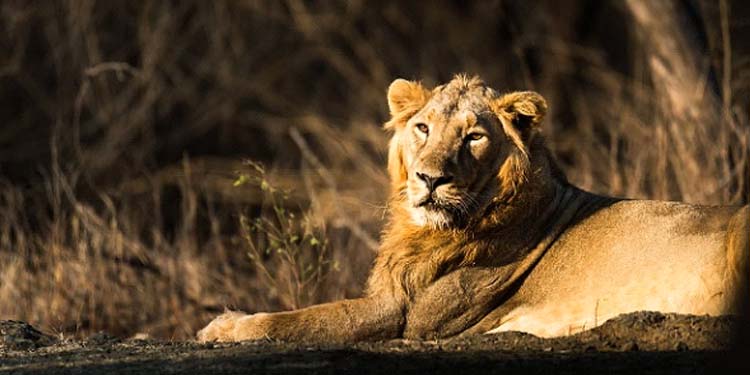
The dwelling f the King of Animals, the majestic lions is what Sasan Gir is famous for. The Gir National park, located at an hours distance from Junagadh is the last refuge of the Asiatic lion on Earth. It is Spread over 2450 hectares, and offers visitors the best in flora and fauna.Sasan Gir Lion sanctuary is definitely one of India's success stories. From a pitiful number of around twenty lions at the turn of the century there are now approximately three hundred lions in the park. Best visited from December to April, the visitors can have a better look if they drive through the park in Jeep. Although the Asiatic lions of Gir, incredibly awe inspiring animals, are supposed to be used to human presence it is always better to be cautious. Best time to view this animal is during early daytime or late in the night. The chinkara, wild boar, striped hyena, jackal, common langur, porcupine, hare and the black buck also share the Jungle with the lions of Gir.
Rajkot
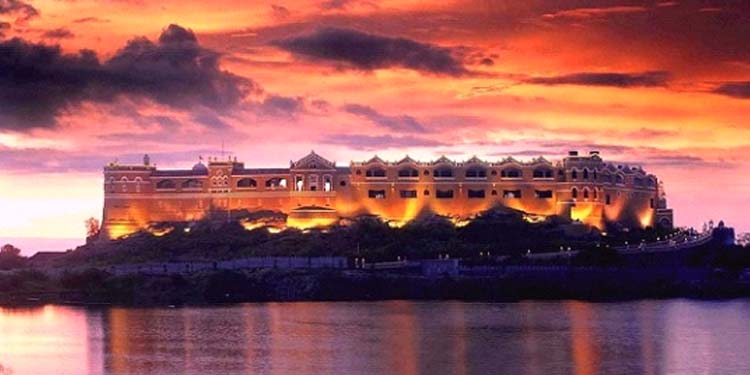
Rajkot literally means the City of the kings, the Rajas. It was founded in the year of 1610 by Vibhaji Jadeja and Raju Sandhi. Today's bustling city was once the princely capital of Saurashtra and later also the Headquarters of the British Raj. The city has a number of impressive colonial buildings and educational institutions. Today its association with the father of the nation, Mahatma Gandhi, is more famous than anything else. Gandhi's father was an employee of the king of Saurashtra and hence the Mahatma's schooling was done from this placeToday Rajkot is a city vibrant with business activities and one of the major cities of Gujarat. The city has a number of impressive colonial buildings and educational institutions. It is famous for its handicrafts like silver and textiles and the highlight of the city is the National weaving institute promoting the traditional weaves.
Dadra and Nagar Haveli
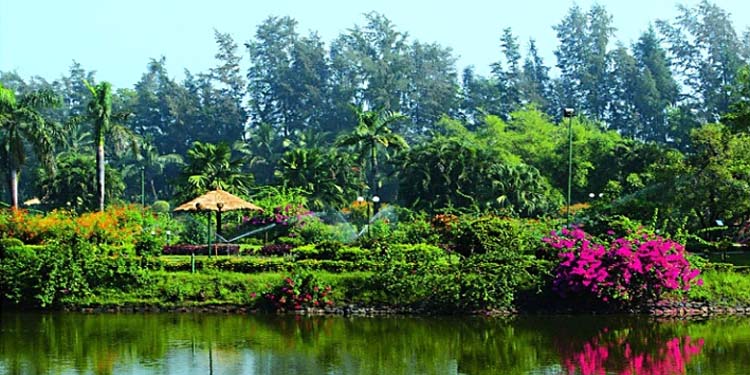
This tranquil magical land of 70 villages, sandwiched between the states of Gujarat and Maharashtra, near Daman, was liberated in 1954 from the Portuguese. Confined to an area of only 491 sq. km, this is the homeland of some simple, brave and colorful tribal, who have enriched it with their rich folklore and vibrant lifestyle.The Union Territory of Dadra and Nagar Haveli enjoy a very pleasant climate from November to March. The temperature is not very high in summer, either. Due to the proximity of the sea, the nights are pleasant.
Saputara
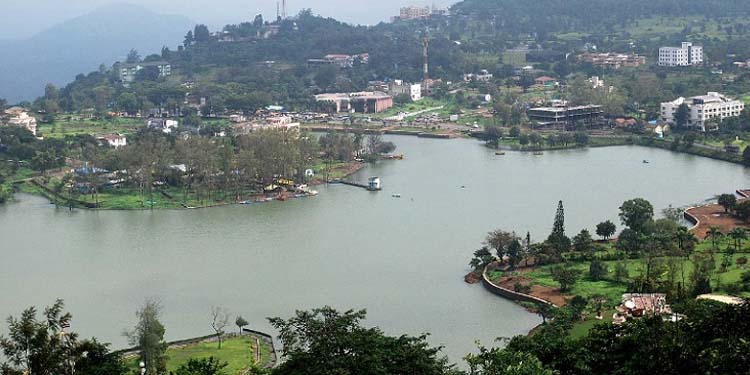
Saputara is Gujarat's picturesque hill station situated at a height of 1100 meters (3600ft) above M.S.L on the Sahyadri range in the Dang District of South borders of Gujarat state. It is rich in its bio-diversity and natural relics. It include in itself many panoramic natural landscape views and rich heritage of its folklore and traditional of the native 'Dangi'. Owing to its location and sites, it developed as a vacation spot or a hill station, for the metropolitan people to make it as their Home away from Home.Any season is a season for visit to Sapuatra, May it be summer, winter or rains. Every season has something exciting to offer to its tourist. Who can roam at various places in the vicinity, like forest of Mahal, Gira Falls etc.
Highlights of Gujarat - 11 Days / 10 Nights
Ahmedabad; Bhuj; Jamnagar; Dwarka; Porbandar; Somnath; Diu; Sasangir; Ahmedabad
Day 01:Ahmedabad To Bhuj (425kms /08hrs Drive)
Arrive Ahmedabad and drive to Bhuj; Arrive Bhuj and transfer to your hotel.
The historic city of Bhuj derives its name from the Bhujiyo Dungar, a hill, overlooking the present day Bhuj town.
Day 02 – In Bhuj
After breakfast visit the villages of Bhuj. Amidst the Desert land of infinite dimensions, are suspended, quaint little villages. These are the last villages on the India-Pakistan border. Overnight at Hotel
Day 03:Bhuj to Jamnagar (340kms /07hrs Drive)
After breakfast drive to Jamnagar; Arrive Jamnagar and transfer to your hotel. Jamnagar or the city of Jams was one of the most important princely states of Saurashtra. Overnight at Hotel
Day 04:Jamnagar To Dwarka (145kms /03hrs Drive)
After breakfast drive to Dwarka; Arrive Dwarka and transfer to your hotel.
The small coastal town of Dwarka is one of the four most holy Hindu pilgrimage sites in India. It is here that Krishna founded his capital after leaving Mathura. Overnight at Hotel
Day 05:Dwarka To Somnath (250kms /05hrs Drive)
Early morning visit the Dwarkadhish Temple and witness the Aarti.
After breakfast drive to Somnath visiting Porbandar en-route. Porbandar, the coastal heritage town of Gujarat is located on the Saurashtra peninsula, on the Arabian Sea.
The legendary shore temple of Somnath is one of the twelve most sacred shrines dedicated to the Lord Shiva. The temple contains the Jyotirlinga of Lord Shiva. Overnight at Hotel
Day 06:Somnath To Diu (100kms /02hrs Drive)
After breakfast drive to Diu; Arrive Diu and transfer to your hotel. A beautiful blend of sun, sand and sea, Diu is a God’s gift to those in quest of a blessed land where the weary weight of this unintelligible world can, for a while, be lightened and the waking soul can hear the music of the nature.
Day 07:Diu
Day is at leisure.
Day 08:Diu To Sasan Gir (120kms /02hrs Drive)
After breakfast drive to Sasan Gir, popularly known as Gir, the most famous lion sanctuary in India. And the one place in the subcontinent where Asiatic Lions can be found in the wild. Sasan Gir is on the south-western border of Saurashtra peninsula in Gujarat and is home to nearly 400 Asiatic lions. Overnight at Hotel.
Day 09:Sasan Gir To To Ahmedabad (375kms /07hrs Drive)
After breakfast drive to Ahmedabad; Arrive Ahmedabad and transfer to your hotel. Ahmedabad is Located on the banks of the river Sabarmati; the city was founded by Sultan Ahmad Shah in 1411. Overnight at Hotel
Day 10:Ahmedabad
After breakfast proceed for city tour of Ahmedabad…which covers Gandhi Ashram, Sidi Sayed Mosque, Jumma Masjid, Teen Darwaja, Hutheesingh Jain Temple, Adalaj Step-well, Akshardham Temple & Etc.
Overnight at Hotel.
Day 11:Depart Ahmedabad
Today in time transfer to Ahmedabad Airport / Railway Station to board flight / train for your onward journey to your further destination.
Incredible Bhuj – Rann of Kutch - 5 Days / 4 Nights
Ahmedabad; Bhuj; Jamnagar; Dwarka; Porbandar; Somnath; Diu; Sasangir; Ahmedabad
Day 01:Arrive Bhuj
Arrive Bhuj and transfer to your hotel.
The historic city of Bhuj derives its name from the Bhujiyo Dungar, a hill, overlooking the present day Bhuj town. Bhuj is a typical example of a desert town located between two geographical features–Bhujiyo Dungar on the east & Hamirsar Lake on the west. Bhuj, the major town of Kutch, is an old city established in 1510. With its surrounding wall, the atmospheric bazaar area, crenelated gateways, old palaces and striking temples the town still retains a medieval character. Every Feb/Mar it hosts the annual Rann Utsav festival. Overnight at Hotel
Day 02:Bhuj
After breakfast visit the Banni Villages. Visit Ajrakhpur and Bhujodi.
he artisans of Ajrakhpur specialize in Ajrakh – a Block Printed cotton cloth used traditionally by local herdsmen with natural dies. Its geometrical and nonfigurative motifs often mirror those appearing in Islamic – influenced Indian architecture. Overnight at Hotel.
Day 02:Bhuj
After breakfast visit the villages of Bhuj. Amidst the Desert land of infinite dimensions, are suspended, quaint little villages. These are the last villages on the India-Pakistan border. Here you will come across master craft people’ exposing their traditional art, turning our master pieces every day. Their ornaments, clothes, utensils, everything they use – will make you feel as if you have stepped into lifestyle museum leaving you spellbound.
Day 04:bhuj – Excursion Mandvi (65kms /1hrs Drive)
After breakfast proceed for day excursion to Mandvi.
Mandvi is located on the banks of the Rukmavati River, barely one km from the Arabian Sea at the Gulf of Kutch. The town has a very pleasant climate throughout the year and it was a summer retreat of the Kutch Maharaos.
Later drive back to Bhuj. Overnight at Hotel
Day 04:Depart Bhuj
After breakfast visit the Kutch Museum, formerly known as the Fergusson Museum. Prag Mahal was constructed by Rao Pragmalji II who appointed a famous architect, Colonel Henry Saint Wilkins to design Prag Mahal, who had earlier designed Deccan College, Sasoon Hospital, Ohel David Synagogue.
Later in time transfer to Bhuj Airport / Railway Station to board flight / train for your onward journey.